Updated 19-December-2025
For students across the UK, GCSE results are more than just a slip of paper; they are a pivotal crossroads. Understanding what these grades truly mean is the first critical step in navigating the academic and professional landscape that follows.
This comprehensive guide demystifies the GCSE grading system, clarifies its implications for your future, and provides a clear, actionable roadmap for students, parents, and educators to move forward with confidence.
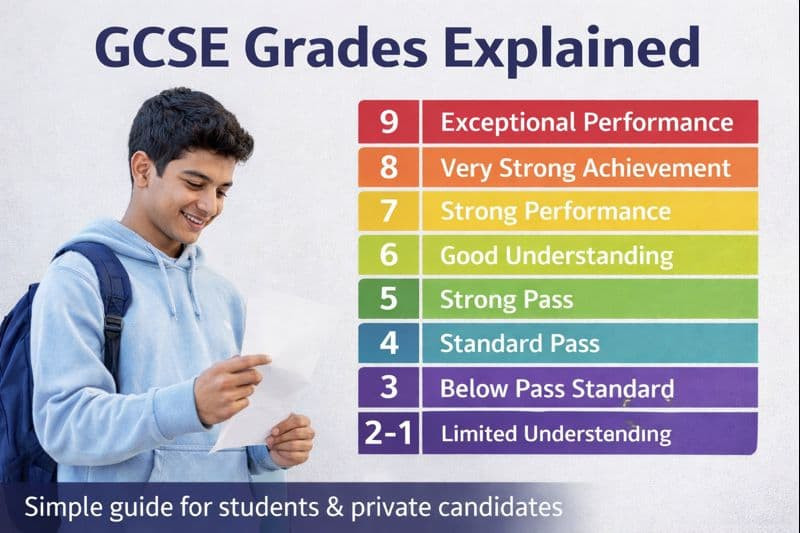
The GCSE grading system in England has evolved from the familiar A* to G letters to a numerical scale of 9 to 1. This change, fully implemented by 2020, was designed to provide greater differentiation between student abilities, especially among high achievers.
The highest grade is 9, with 1 being the lowest. A ‘U’ signifies an ungraded result. While not a direct one-to-one match, the numerical and letter scales align at key points to help with comparison:
A grade 7 aligns with the bottom of a grade A.
A grade 4 aligns with the bottom of a grade C.
A grade 1 aligns with the bottom of a grade G.
Grades 9, 8, and 7 collectively cover the old A* and A range, with a grade 9 representing a high A. This system offers six distinct grades between the old C and A threshold, allowing for more nuanced recognition of achievement.
Contrary to popular belief, there is no universal fixed percentage for each grade. Grade boundaries are set by exam boards each year based on the difficulty of the papers and national performance data. This process of "awarding" ensures fairness, making it no easier or harder to achieve a specific grade from one year to the next.
For students, two grades hold particular importance:
Grade 4: Considered a "standard pass." This is the minimum level often required for progression to many Level 3 courses, such as A-Levels.
Grade 5: Deemed a "strong pass." This is the benchmark used by the government for school league tables and is increasingly the expected standard for entry into further education.
It’s crucial to remember that GCSEs are a significant milestone, not the final destination. They are a snapshot of performance in a specific set of assessments. A holistic view of a student's skills, resilience, and extracurricular achievements is equally vital for long-term success.
GCSE results directly influence post-16 options. Competitive sixth forms and colleges often require a minimum of five grades at 5 or above, including English and Maths, for A-Level programmes. Specific A-Level subjects may require a 6 or 7 in the corresponding GCSE. For those considering a more vocational route, T Levels and apprenticeships will also have specific GCSE requirements, particularly in core subjects.
Employers do value GCSEs; 76% say they form an important part of their recruitment process for school leavers, as they demonstrate foundational competency in core skills like literacy and numeracy. However, a significant shift is occurring. Research indicates that 70% of employers believe there is too much focus on grades alone. They frequently identify gaps in soft skills, such as communication, time management, and preparedness for the workplace.
This underscores a critical insight: strong GCSEs open the door, but well-rounded skills secure the opportunity. For expert guidance on selecting the right subjects to align with your career aspirations, consider booking a consultation with our education pathway advisors.
Congratulations! This is the moment to solidify your next steps. Confirm your place in your chosen sixth form, college, or apprenticeship. Use this confidence as a foundation for the next stage of your learning. If you’re exploring private education options for A-Levels, our centre offers a range of accredited A-Level courses in a supportive environment.
Don't Panic: This is a common situation with clear pathways forward.
Speak to Your Teachers Immediately: They can provide specific advice, clarify remarking options, and discuss potential grade boundaries.
Explore Remarking (Reviews of Marking): If you were close to a grade boundary, a review may be an option. Requests must typically go through your school by a late September deadline. It’s important to know that marks can go down, stay the same, or go up as a result of a review.
Consider Resits: Core subject resits (English Language and Maths) are available in the autumn. For other subjects, resits are typically taken the following summer. We offer focused GCSE retake programmes designed to build confidence and secure that crucial grade improvement.
Be Flexible with Your Plans: Discuss alternative courses with different grade requirements at your chosen institution or others nearby.
Investigate Apprenticeships: These provide excellent alternatives, combining paid work with structured training and qualifications.
The educational landscape continues to evolve. The move towards final exams and the 9–1 grading scale reflects a focus on robustness and differentiation. Future reforms may further integrate digital assessment and continue to balance academic rigour with student wellbeing.
Ultimately, success beyond GCSEs hinges on cultivating resilience, adaptability, and a proactive mindset. These are the true currencies of the modern workplace. Engaging in activities that build these skills—be it part-time work, volunteering, or personal projects—is an invaluable complement to academic achievement.
GCSE results are a powerful indicator of your current academic understanding and a key to unlocking future doors. However, they do not define your potential. By thoroughly understanding the grading system, strategically planning your next steps, and focusing on developing a broad suite of skills, you can navigate this transition effectively.
Whether you are celebrating your results or recalibrating your plans, remember that education is a journey. With the right support, strategy, and mindset, you can build a successful and fulfilling future from your GCSE starting point.
Are you seeking a flexible, supportive environment for your GCSE studies or retakes? Contact Private Exams Centre today to learn how our tailored programmes and expert tuition can help you achieve your academic goals.
Q1: What is considered a “good” GCSE grade?
A good GCSE grade depends on your goals. A grade 4 is regarded as a “standard pass,” while a grade 5 is considered a “strong pass” and is increasingly required for progression to further education. Higher grades (6–9) are often needed for competitive A-Level courses.
Q2: Is a GCSE grade 5 better than a grade 4?
Yes. While both are passes, a grade 5 is a “strong pass” and is the government’s benchmark for school performance. Many sixth forms and colleges prefer or require grade 5, particularly in English and Maths.
Q3: What happens if I don’t pass Maths or English GCSE?
If you achieve a grade 3 or below in GCSE Maths or English, you are usually required to resit the subject. Resits are commonly taken in the autumn or the following summer, depending on the subject and exam board.
Q4: Can GCSE grades be changed after results day?
Yes. Students can request a review of marking (remark) if they believe their grade does not reflect their performance. However, marks can increase, decrease, or remain the same, and strict deadlines apply.
Q5: Do employers really care about GCSE grades?
Many employers consider GCSE grades as evidence of basic literacy and numeracy skills. However, employers increasingly value soft skills such as communication, reliability, and adaptability alongside academic results.
Q6: Are GCSE grades more important than A-Levels or other qualifications?
GCSEs are foundational qualifications and play a key role in accessing post-16 education. However, they are not the final measure of ability. A-Levels, vocational qualifications, apprenticeships, and work experience also strongly influence long-term opportunities.
Recent Posts
Categories
Tags